Business software in simple terms
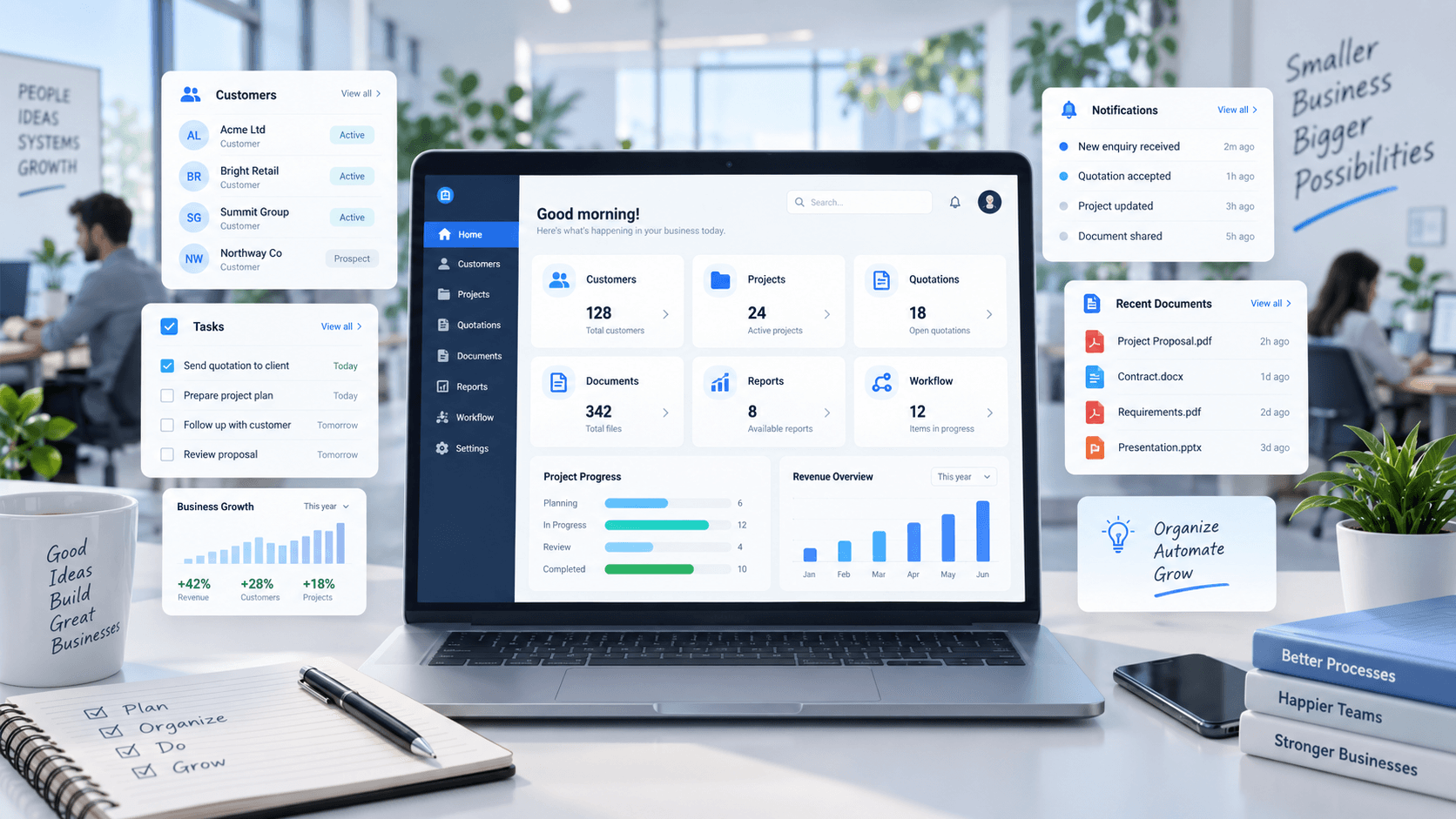
Business software is a digital system designed to help a company manage its daily operations. Instead of relying on spreadsheets, messaging apps, paper records and disconnected tools, businesses can use structured software to manage customers, projects, documents, tasks, enquiries, quotations and operational information in one organised workflow.
Why manual processes become difficult as a business grows
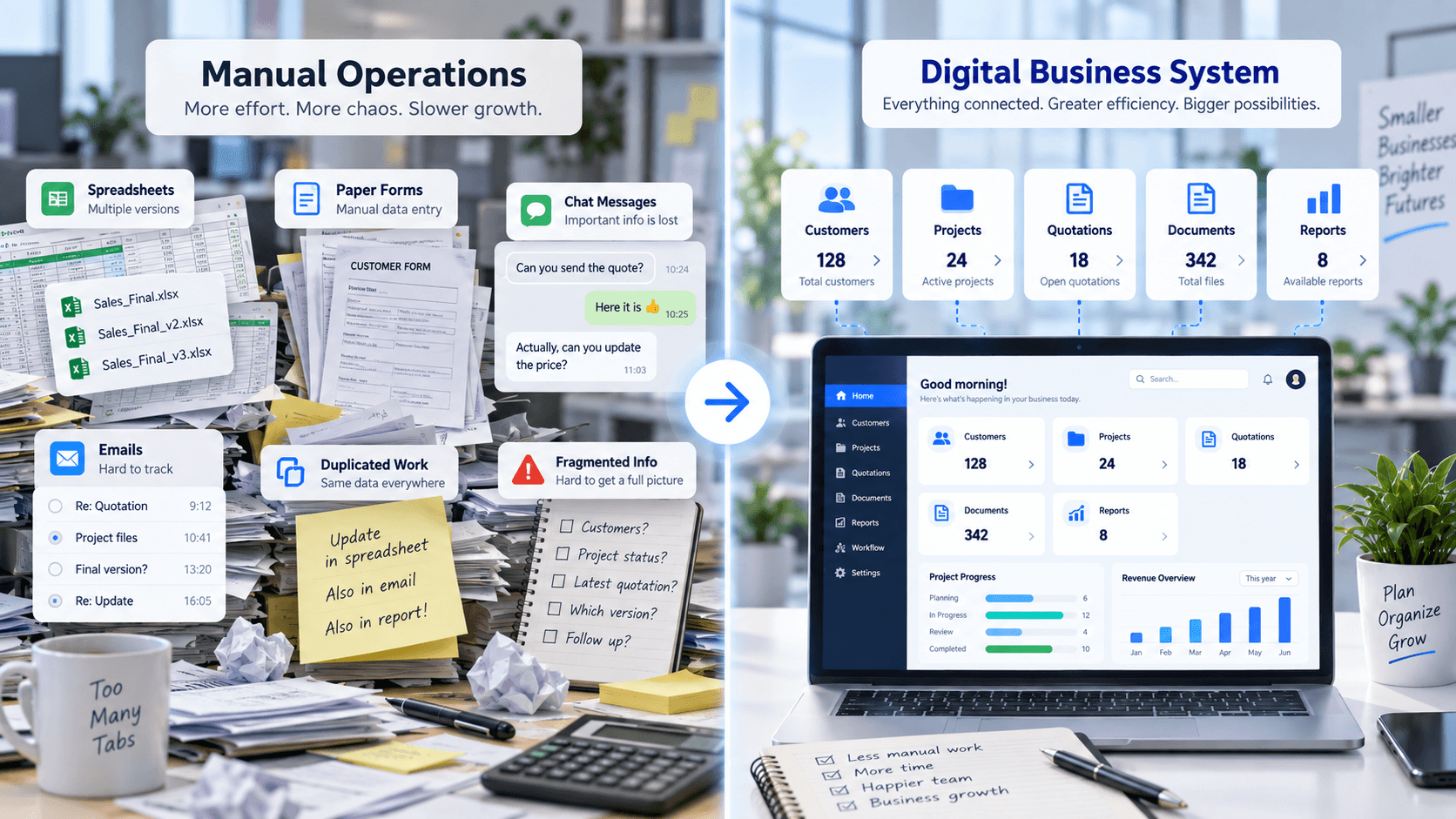
Manual processes may work when a business is small, but they often become harder to manage as customers, projects and information increase. Important details can become scattered across spreadsheets, WhatsApp conversations, emails and paper documents, making it difficult to maintain consistency and visibility.
Common operational problems
Scattered information
Customer, project and operational data may be stored across different files, messages and devices.
Repeated manual work
Employees repeatedly copy information, update spreadsheets and prepare similar documents.
Limited visibility
Business owners may struggle to see project status, enquiries, sales opportunities and pending work clearly.
Inconsistent processes
Different employees may manage the same type of work in different ways.
What can business software manage?
A business system can be designed around the specific workflow of a company. It does not need to be complex. Even a focused system can significantly improve how operational information is organised.
Customer Management
Store customer details, contact history and important business information.
Project Management
Track project progress, responsibilities, status and important updates.
Enquiry Management
Capture new customer enquiries and ensure they are followed up properly.
Quotation Management
Prepare, organise and track quotations in a consistent workflow.
Document Management
Keep important business documents organised and easier to retrieve.
Reporting
Provide useful operational summaries and management visibility.
Example: a contractor business without a central system
A contractor may receive a customer enquiry through WhatsApp, save the customer's details in a phone, prepare an estimate in a spreadsheet and send the quotation as a separate document. Project updates may then be shared through different message groups. This works initially, but information becomes increasingly difficult to manage as project volume grows.
The same workflow with business software
With a central business system, the customer enquiry can become a structured record. Project requirements, quotation status, customer communication and project progress can then be managed through one connected workflow.
A simple digital business workflow
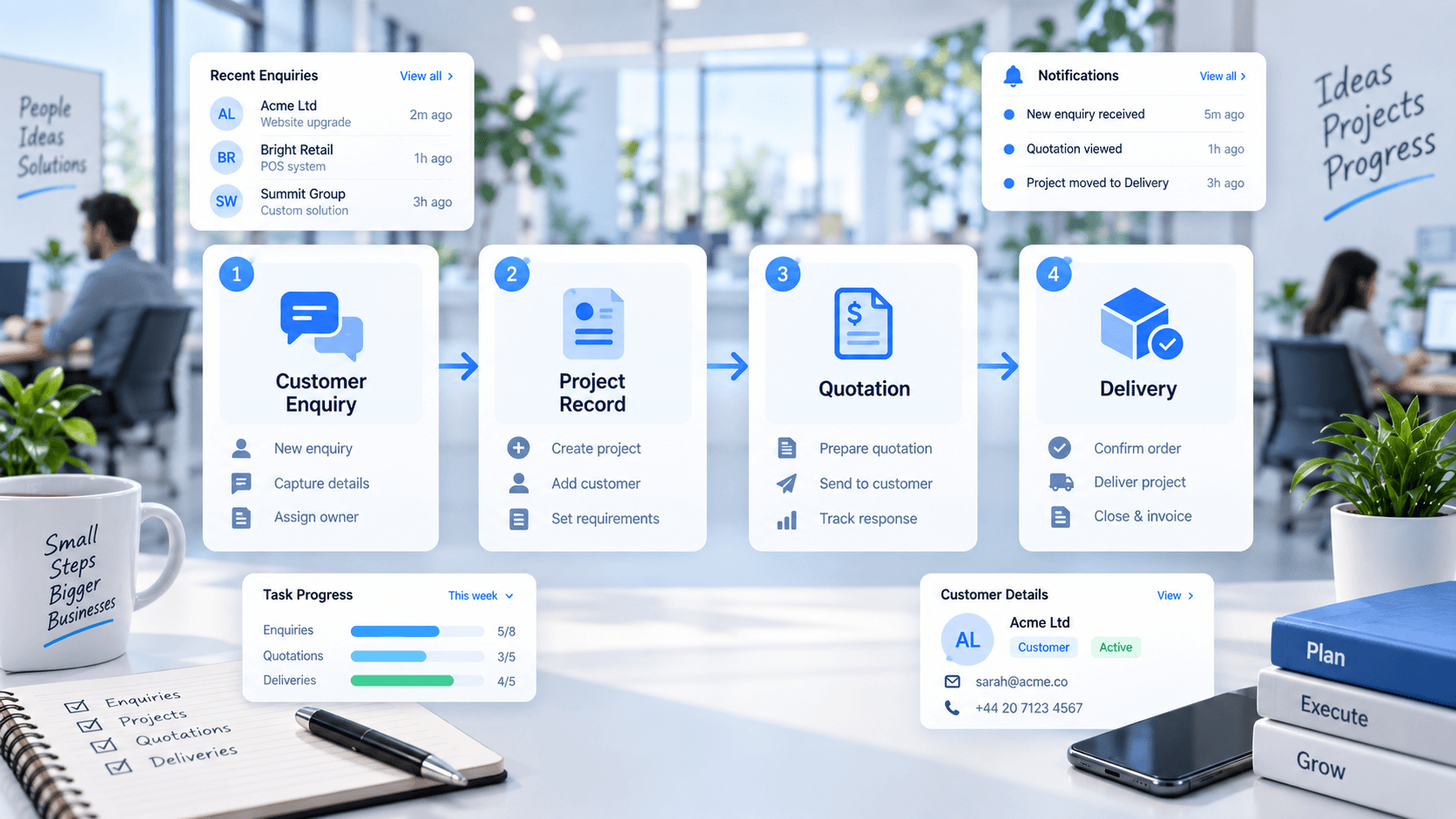
01
Customer Enquiry
The business captures customer and project information in a structured format.
02
Project Record
The enquiry becomes a project or sales opportunity inside the system.
03
Quotation
The team prepares and tracks the quotation through a consistent process.
04
Project Delivery
Project progress, updates and important information stay connected to the same record.
What are the benefits of business software?
Better organisation
Important business information is easier to find and manage.
Less administrative work
Structured workflows reduce repeated manual updates and duplicate work.
Improved visibility
Owners and teams can understand the current status of business activities more clearly.
More consistent operations
Standard workflows help teams perform important processes in a repeatable way.
Faster customer response
Customer information and enquiry status are easier to access when follow-up is needed.
Foundation for automation
Once information is structured, the system can later support automation and AI capabilities.
Business software does not need to replace everything
A company does not need to replace every existing tool immediately. A practical approach is to identify the workflows that create the most operational friction and build or introduce software around those areas first.
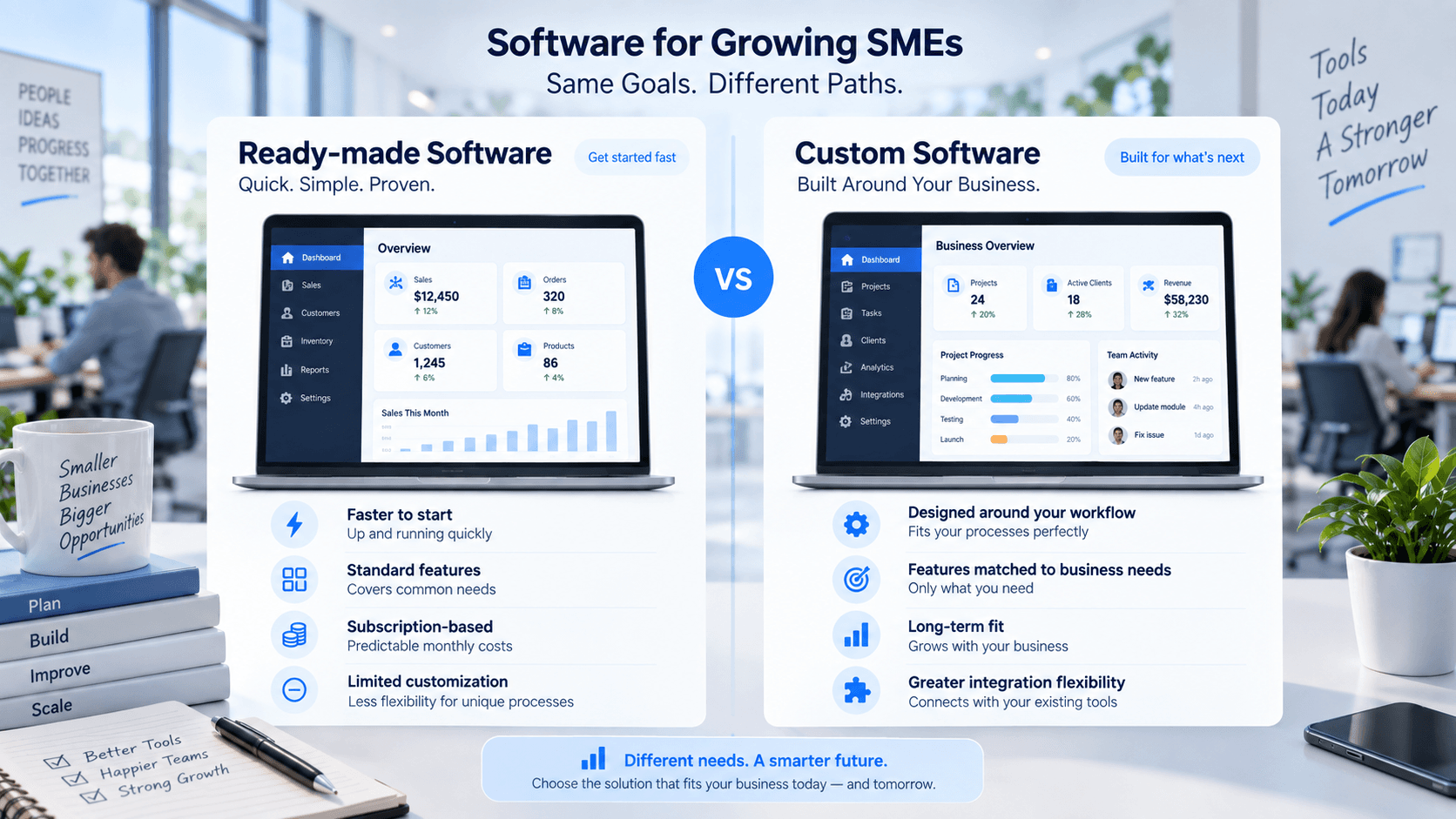
Custom software vs ready-made software
Ready-made software can be useful when business requirements are standard. Custom software becomes valuable when a company has specific workflows, industry requirements or processes that generic tools cannot handle effectively.
Choosing the right approach
Start with the business problem, not the technology
The most useful business software starts with a clear operational problem. The goal is not to build as many features as possible. It is to identify where time is being lost, where information becomes difficult to manage and where a digital system can make the workflow simpler and more reliable.
Business software creates structure for growth
As an SME grows, organised digital workflows become increasingly important. Business software can provide the structure needed to manage customers, projects, documents and operations more effectively while creating a stronger foundation for future automation and AI.